In-Home Physical Therapy — Northern Virginia & Washington DC
Doctoral-level rehabilitation delivered to your door — no clinic, no waiting room, no compromise.
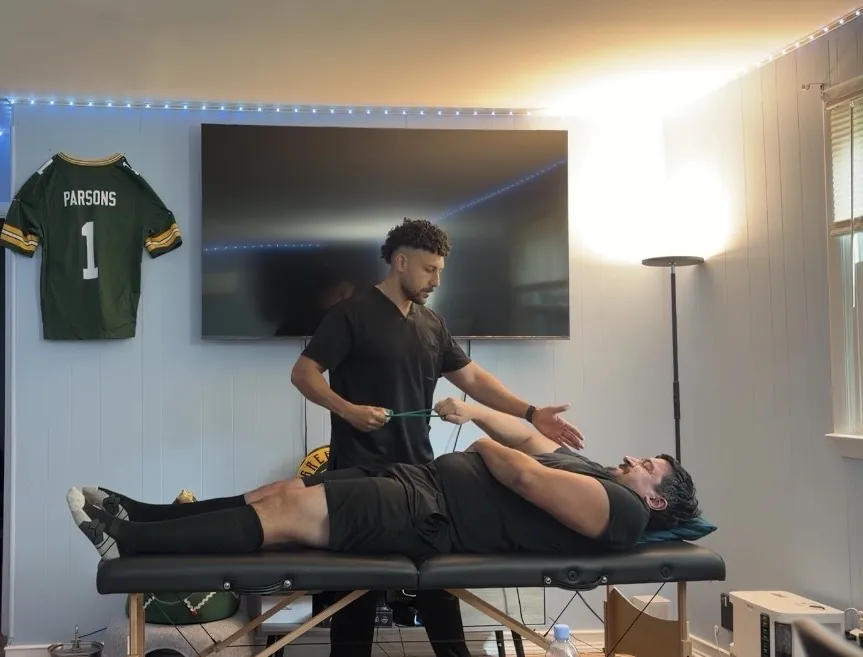
When movement becomes painful, getting to a clinic can feel impossible — and when you finally do get there, you spend 45 minutes of a 60-minute appointment waiting, then see three different aides before your actual therapist arrives for 10 minutes. PTN Fitness eliminates all of that. A Doctor of Physical Therapy comes directly to your home in Northern Virginia and Washington DC, bringing clinical-grade equipment, doctoral-level expertise, and 60 uninterrupted minutes of one-on-one care. No waiting rooms. No aides. No handoffs. The same clinician, every visit, who knows your case in full.
Conditions We Treat at Home
- Back pain, sciatica, and disc herniations
- Neck pain, cervicogenic headaches
- Post-surgical rehab (knee, hip, shoulder, spine)
- Arthritis and joint degeneration
- Chronic pain and central sensitization
- Balance deficits and fall prevention
- Sports and musculoskeletal injuries
- Hypermobility and connective tissue disorders
What Every Session Includes
Every visit opens with a progress check and plan adjustment. You never follow the same script twice — your treatment evolves as your body does. Below are the clinical tools your DPT draws from during every home visit. Click any item to learn exactly what it is and how it works.
Manual therapy is the cornerstone of hands-on physical therapy — a family of skilled, passive techniques applied directly by your therapist to joints, muscles, nerves, and connective tissue. Unlike exercise, manual therapy works on structures you cannot voluntarily activate or release on your own. It is the primary reason seeing a Doctor of Physical Therapy in person produces faster results than a home exercise program alone.
Techniques used at PTN Fitness
- Joint mobilization (Maitland Grades I–IV): Graded oscillatory movements applied to stiff or painful joints to restore arthrokinematic motion — the small gliding, rolling, and spinning motions that must occur for pain-free range of motion.
- High-Velocity Low-Amplitude (HVLA) manipulation: The rapid, targeted thrust technique that produces the cavitation “pop.” Used selectively for facet joint restrictions in the spine, SI joint, and peripheral joints when indicated.
- Soft tissue mobilization (STM): Direct, sustained pressure into restricted muscle tissue and fascia to break adhesions, improve extensibility, and restore normal muscle length-tension relationships.
- Myofascial release: Sustained, low-load pressure held for 90–120 seconds to allow the fascial system to unwind and release. Particularly effective for chronic, diffuse pain patterns.
- Neural mobilization (neurodynamics): Gentle mobilization of the peripheral nervous system — the sciatic nerve, median nerve, radial nerve — to reduce mechanosensitivity in conditions like sciatica, carpal tunnel, and thoracic outlet syndrome.
- Instrument-Assisted Soft Tissue Mobilization (IASTM): Stainless steel tools used to detect and treat fascial restrictions, scar tissue, and chronic tendinopathy with controlled micro-shearing force.
Therapeutic exercise is not “going to the gym” and not a generic printout of stretches. It is a clinically reasoned, individually prescribed movement program designed around your specific diagnosis, your current tissue capacity, and your functional goals — progressed visit by visit by the same DPT who evaluated you. Every set, every rep is observed and corrected in real time.
What makes therapeutic exercise different
- Motor control retraining: After injury, the nervous system changes how it recruits muscle. Therapeutic exercise restores correct firing sequences — particularly deep stabilizers like multifidus, transversus abdominis, and rotator cuff — before loading superficial muscles.
- Progressive overload with clinical precision: Load, range, tempo, and complexity are increased in a controlled sequence. Tissue heals at a predictable rate; your program respects that biology rather than pushing past it.
- Neuromuscular re-education: Proprioceptive and balance exercises that restore the brain’s accurate map of where your body is in space — critical after ankle sprains, ACL injuries, and any surgery involving joint replacement.
- Pain science-informed pacing: For chronic pain and central sensitization, exercise dosing is calibrated to the nervous system’s tolerance, not just tissue capacity — avoiding boom-and-bust cycles that derail recovery.
- Your home is the gym: Your program uses equipment you actually own. Resistance bands, a chair, a wall, your own bodyweight — no gym membership required. Compliance goes up dramatically when the program fits real life.
Pain relief is not the finish line — it is the starting line. Functional training bridges the gap between “my pain is better” and “I can do everything I need to do.” It means training the exact movements that your daily life demands, in the environment where those demands actually occur. Your home is uniquely positioned for this: the stairs you climb, the floor you need to get off, the car you need to get in and out of are all right there.
Examples of functional training at home
- Sit-to-stand progressions: From chair height to low surface to floor, building the quad strength and hip mobility needed for independent daily living — the single most clinically meaningful movement for older adults.
- Stair negotiation training: Step pattern, rail use, load distribution, and confidence — particularly important post knee or hip surgery.
- Gait retraining: Correcting altered walking patterns that developed during injury or post-surgery, before compensatory patterns become permanent.
- Sport and activity return: Athletes return to running, cutting, pivoting, overhead reaching, and sport-specific loading under controlled supervision before returning to full play.
- Occupation-specific training: We replicate the demands of your job — prolonged standing, lifting, repetitive reaching — and build the capacity to perform them without pain.
Dry needling is a technique in which a thin, sterile monofilament needle is inserted directly into a myofascial trigger point — a hyperirritable nodule within a taut band of muscle that refers pain, limits range of motion, and disrupts normal muscle function. It is called “dry” because no substance is injected; the needle itself is the intervention.
Dry needling is grounded in the work of Travell and Simons and supported by a growing body of randomized controlled trials showing significant reductions in pain intensity, trigger point sensitivity, and disability for conditions including cervicogenic headache, shoulder impingement, low back pain, plantar fasciitis, and lateral epicondylalgia (tennis elbow).
What happens during the session
- Your DPT identifies trigger points through manual palpation and your symptom map.
- A sterile needle is inserted into the trigger point. You may feel a brief “twitch response” — an involuntary local muscle contraction that is a positive sign indicating you have found the right spot.
- The needle is then manipulated or simply left in place for 30–90 seconds depending on technique.
- Post-needling soreness, similar to post-exercise soreness, is normal and typically resolves within 24–48 hours.
How it differs from acupuncture
- Dry needling targets neuromuscular anatomy — trigger points, motor points, and musculotendinous junctions — based on Western musculoskeletal science.
- Acupuncture targets meridian pathways based on Traditional Chinese Medicine theory.
- At PTN Fitness, dry needling is always integrated into a comprehensive PT plan — it is a powerful adjunct, not a standalone procedure.
An assistive device that is the wrong size, used with the wrong technique, or used for too long will create new injuries while masking the old ones. Cane height, walker grip position, crutch axillary clearance — these are not trivial details. They determine whether your gait mechanics remain sound or whether you develop secondary hip, shoulder, and wrist problems on top of your primary diagnosis.
What assistive device training covers
- Proper fitting and sizing: Cane height, walker height, crutch length — measured and adjusted to your body dimensions, not approximated from a hospital discharge instruction sheet.
- Gait pattern training: Two-point, three-point, and four-point crutch patterns; step-to and step-through walker patterns; correct cane use on stairs (good side up, affected side down).
- Weight-bearing compliance: Post-surgical weight-bearing precautions (TTWB, PWB, WBAT, FWB) are enforced and trained — reducing the risk of hardware failure or wound complications.
- Brace and orthotic instruction: Correct donning/doffing, wearing schedules, skin inspection, and activity-specific application of prescribed braces and AFOs.
- Progressive weaning: A structured, criteria-based plan to reduce reliance on the device as strength and balance improve. Staying on a cane longer than necessary delays recovery; weaning too soon risks re-injury.
Fear is one of the most powerful drivers of disability. Patients who understand what is happening in their body — what the pain means, what it does not mean, and what they can safely do — recover faster, return to activity sooner, and have lower rates of chronic pain development than patients who only receive hands-on treatment. Education is not a soft add-on; it is a primary intervention with measurable outcomes.
Pain Neuroscience Education (PNE)
- Based on the Moseley & Butler model, PNE teaches you how pain is produced by the nervous system rather than simply by tissue damage — a paradigm shift that is particularly powerful for chronic pain, fibromyalgia, and central sensitization.
- Understanding that a disc bulge seen on MRI does not equal pain, or that catastrophizing amplifies the pain signal, reduces fear-avoidance behavior and allows you to move more confidently.
Activity and load management
- Pacing strategies for chronic pain: how to use a quota-based approach instead of a pain-contingent approach to gradually expand your activity envelope.
- Identifying specific aggravating postures, positions, and movements and understanding why they provoke symptoms — so you can modify them intelligently rather than avoiding all activity.
Flare-up planning
- A written flare-up management protocol so you know exactly what to do when pain spikes: which activities to modify, which exercises to use, when to apply heat vs. ice, and when to contact your DPT.
- Self-management reduces emergency visits, unnecessary imaging, and medication use — and gives you confidence that you can handle a bad day without a crisis.
You can do every exercise in your plan correctly and still not improve if you spend eight hours a day at a desk that is loading your spine, shoulders, or wrists in exactly the wrong way. Ergonomic assessment identifies and corrects the environmental contributors to your pain that no amount of manual therapy can permanently fix on its own.
Because we treat you at home, we assess your actual workspace — not a hypothetical one reconstructed from your description in a clinic. We see your monitor height, your chair, your keyboard position, the way you hold your phone, and how you sit when you are tired at 3pm, not how you sit when someone is watching.
What the assessment covers
- Workstation analysis: Monitor height (eye level ± 5°), viewing distance (20–28 inches), keyboard and mouse position (elbow at 90°, wrists neutral), chair height (hips at or above knee level), lumbar support adequacy, and screen glare.
- Seated posture habits: Identification of habitual forward head, thoracic kyphosis, crossed-leg sitting, and side-leaning patterns — and specific corrective strategies for each.
- Standing desk protocols: Anti-fatigue mat use, alternating sit-stand schedules (20–8–2 rule), footwear assessment for prolonged standing.
- Phone and tablet use: Neck flexion angle management for text neck — a 60-degree forward head posture produces approximately 60 lbs of force on the cervical spine.
- Kitchen and home environment: Counter height for food prep, bathroom grab bar placement, car seat positioning for lumbar support, and sleeping surface evaluation.
Your body heals at night — or it does not, depending entirely on what position you sleep in. Six to eight hours in a position that loads an inflamed joint, compresses a nerve root, or keeps an already-shortened muscle in its shortened position actively counteracts everything achieved in your treatment session. Sleep position is a clinical priority, not an afterthought.
Common sleep-related pain patterns we address
- Cervical pain and morning stiffness: Pillow height is the single most impactful variable. Too high or too low creates lateral cervical flexion or forward head position sustained for hours. We measure and prescribe the correct pillow height and firmness for your neck curve and sleep position preference.
- Shoulder pain: Side-lying on the affected shoulder compresses the rotator cuff against the acromion for hours. We teach modified side-lying with a strategically placed pillow to offload the shoulder while maintaining patient preference.
- Low back pain: Prone sleeping (face down) hyperextends the lumbar spine and rotates the cervical spine. Supine without a pillow under the knees increases lumbar lordosis. We correct both with simple positioning props available in your own home.
- Hip and knee pain: For hip OA and bursitis, a pillow between the knees in side-lying neutralizes adduction and internal rotation forces on the hip. For knee pain, avoiding full extension in supine prevents posterior capsule tension.
- Post-surgical positioning: After shoulder, hip, or knee replacement, specific position restrictions and supported positioning are critical for wound healing and implant protection during the first 6–12 weeks.
How it works: Book online or call (571) 306-0250. Confirm your address in Northern Virginia or Washington DC. Your DPT arrives with all clinical equipment needed to assess and treat. The first session includes a comprehensive movement and strength assessment before any hands-on treatment begins — because treatment without assessment is guesswork.
We Help People Who…
If any of these sound familiar, you are exactly who PTN Fitness was built for.
Finished PT but still not 100%
You completed your insurance-covered visits but still feel weak, stiff, or cautious. You need someone who can bridge the gap between “cleared” and truly ready.
Want to exercise but are afraid of reinjury
Every time you try to get active, something flares up. You need a trainer who can keep you safe and progressing at the same time.
Struggle with back pain at the desk
Hours of sitting are destroying your posture and your lower back. You need a plan that addresses the root cause — not just the pain where you feel it.
Cannot make it to a clinic
You travel for work, care for a family member, or simply cannot afford to lose an hour commuting both ways. You need expert care that comes to you.
Want to train at the next level
You are active and ambitious — pickleball, golf, hiking, running, lifting. You want a coach who can push your performance without creating new injuries.
Feel like you were just handed off to a tech
You paid for a physical therapist and spent most of your visit with an aide doing generic exercises. You deserve a Doctor-to-patient session, every single time.
We coordinate with your surgeon or physician on request, so your whole care team stays informed.
What patients say on Google
5.0 from 16 Google reviews · See all reviews · Read them on Google (opens in a new tab)
“Michail is the best physical therapist I have ever worked with. I have had back issues resulting from a herniated disc for the past 9 years and have struggled to find a PT that gave me noticeable results until I met Michail. He also can come to you which is extremely convenient.”
“I suffered from an ankle injury, and consulted Dr. Baskaron regarding a treatment plan. He was able to assist me with in-home PT to accommodate my schedule and was very realistic with the healing goals. I’m very thankful for the experience and definitely recommend!”
“I went from not being able to even sit, struggling to walk, couldn’t even enjoy a simple walk or play a sport to being able to get back into the groove of sports and going to work not in pain. Highly recommend him and his services to anyone who will be serious and committed to his plan.”
Reviews are shared exactly as posted on Google, shortened where marked (…). Individual results vary.
Bring Expert Care to Your Door
Same-week appointments available. PTN Fitness serves Arlington, Alexandria, Fairfax, McLean, and greater Northern Virginia and Washington DC.
Prefer to pick a time yourself? Book online with Jane (opens in a new tab) (free account). Or text us.